

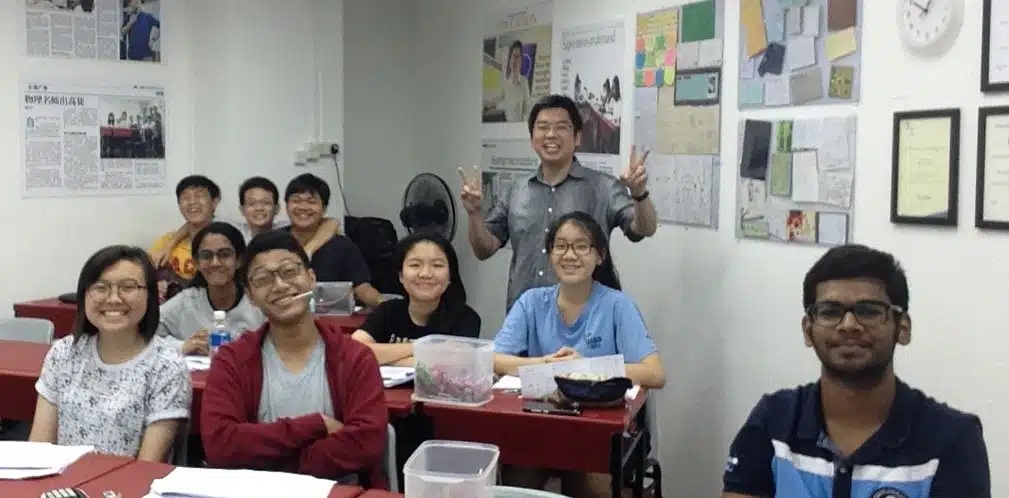

Parents looking for Best Physics Tuition Potong Pasir are often trying to solve a specific problem: their child keeps losing marks in the same parts of Physics. The student may study hard, attend school lessons, and complete homework, yet the same weak spots appear in tests. This is frustrating because the effort is real, but the results do not fully reflect it.
Common weak spots are not random. In O-Level and lower JC Physics, they usually cluster around a few areas: kinematics, forces, moments, electricity, thermal physics, waves, graph interpretation, and written explanations. Once these patterns are identified, students can stop revising blindly and start repairing the exact skills that are holding them back.
Why Physics Weak Spots Repeat
Physics is cumulative. A weak understanding of vectors affects kinematics. Weak free-body diagrams affect dynamics. Poor unit discipline affects calculations across almost every topic. Because skills overlap, one early gap can appear again and again under different chapter names.
This is why a student may feel as if every topic is difficult, when the real issue is smaller and more specific. For example, a student who struggles to interpret gradients may lose marks in motion graphs, cooling curves, circuit experiments, and practical data questions. The topic changes, but the underlying skill weakness is the same.
Weak Spot 1: Kinematics and Motion Graphs
Kinematics often looks simple until graphs appear. Students may memorise that gradient means acceleration or that area under a velocity-time graph gives displacement, but they do not always understand why. When a graph is curved, split into sections, or described in words, they become unsure.
The fix is to connect each graph feature to real motion. A steeper displacement-time graph means faster motion. A negative gradient means movement in the opposite direction. A horizontal line on a velocity-time graph means constant velocity, not rest. Students need repeated practice translating between words, graphs, and equations until the links become automatic.
Weak Spot 2: Forces and Free-Body Diagrams
Forces are another common source of confusion. Students often know the names of forces but fail to draw them correctly. They may forget friction, mix up weight and mass, or assume the normal force is always equal to weight even when the object is on a slope or accelerating.
A free-body diagram should be the starting point for any force question. It forces the student to identify what acts on the object, in which direction, and whether the forces are balanced. Without that diagram, Newton’s laws become guesswork. With it, the equation often becomes clear.
Weak Spot 3: Moments and Turning Effects
Moments are difficult for students who try to memorise formulas without visualising the turning effect. The idea of perpendicular distance from the pivot is often misunderstood. Students may use the wrong distance, forget units, or ignore whether clockwise and anticlockwise moments are balanced.
A practical way to teach moments is to connect them to doors, spanners, seesaws, and balance. The further the force is from the pivot, the greater the turning effect for the same force. Once students understand the physical idea, the formula becomes easier to apply correctly.
Weak Spot 4: Electricity and Circuit Reasoning
Electricity is a topic where memorisation fails quickly. Students may remember formulas such as V equals IR, but struggle when a circuit changes. They may not understand why current is the same in series, why voltage is shared, or why adding a parallel branch changes total resistance.
Circuit questions should be approached by asking what is connected in series, what is connected in parallel, and what stays the same in each part of the circuit. A student who can reason through these relationships will handle unfamiliar diagrams better than one who memorises a few standard examples.
Weak Spot 5: Explanation Questions
Many students lose marks not because they do not know the answer, but because they cannot express the reasoning clearly. They write a keyword and stop. O-Level Physics often requires a chain of reasoning: cause, effect, and link to the concept. A vague explanation rarely earns full marks.
For example, in a thermal question, a strong answer may need to mention temperature difference, energy transfer, and the direction of heat flow. In a forces question, the student may need to connect resultant force to acceleration. Learning to write these links is an exam skill, not just an English skill.
How to Review a Structured Answer After Marking
After a structured question is marked, students should not only copy the correct answer. They should compare their response with the mark scheme and identify which link was missing. Was the concept named but not applied? Was the graph described but not explained? Was the formula correct but the unit absent? This review turns one question into a lesson for the next one.
A useful habit is to rewrite one weak answer in full after every practice session. The goal is not to memorise that exact answer. The goal is to practise building a complete chain of reasoning, using the kind of precise Physics language that examiners reward.
How to Diagnose the Real Weak Spot
The best evidence comes from marked work. Parents and students should look beyond the total score and ask where marks were lost. Were the mistakes mostly definitions, calculations, diagrams, graphs, or explanations? Did the student lose marks early in the question and then carry the error forward? Did they leave application questions blank?
Once the pattern is clear, practice should become narrower. A student weak in motion graphs does not need random revision across all chapters. They need repeated, guided work on graph interpretation, followed by mixed practice to check whether the skill transfers.
Why School Test Scores Alone Are Not Enough
A score tells parents that something went wrong, but it rarely explains what went wrong. Two students can both score 60 percent for completely different reasons. One may have weak content knowledge, while another may understand the topics but lose marks through careless presentation and incomplete explanations.
This is why the quality of error review matters. A good review separates the symptom from the cause. The symptom is a lost mark. The cause may be a missing diagram, a misunderstood definition, weak algebra, or a failure to connect the answer to the scenario. Fixing the cause is what prevents the same error from returning.
How TGC Academy Supports Targeted Repair
TGC Academy in Potong Pasir helps students work on Physics weak spots by focusing on both content and exam method. The aim is to identify the recurring issue, correct it with explanation and practice, then revisit it until the student can apply the skill independently.
This kind of targeted repair is especially useful for students who are putting in effort but not seeing matching results. Instead of telling them to study harder, it shows them what to study differently. That shift can reduce frustration and make revision feel more purposeful.
Frequently Asked Questions
How can I tell if my child has a Physics weak spot?
Look for repeated mistakes across several tests. If the same kind of error appears in different topics, the issue is likely a specific skill weakness rather than one bad paper.
Are weak spots usually caused by poor effort?
Not always. Many students try hard but use inefficient methods. They may memorise instead of understanding, or practise questions without reviewing the reason for each mistake.
Which weak spot should be fixed first?
Start with the weakness that appears most often or affects several topics. Units, graphs, diagrams, and explanations are common high-impact areas.
Can a student fix weak spots close to the exam?
Some habits can improve with focused practice, but earlier is better. Last-minute correction is harder because the student is also dealing with content revision and time pressure.
Should parents request more homework to fix weak spots?
More homework helps only if it is targeted. A smaller set of carefully chosen questions with proper review is often better than a large pile of random worksheets.
Physics becomes more manageable when students stop treating every mistake as a mystery. Most weak spots have a pattern, and patterns can be corrected. For Potong Pasir students, focused local support can help turn repeated errors into specific skills to practise and improve.
TGC Academy (Potong Pasir) Location Details
- Business Name: TGC Academy (Potong Pasir)
- Address: 107 Potong Pasir Ave 1, #01-K1, Singapore 350107
- Phone: +65 8920 0792
- Email: [email protected]
- Website: https://www.tgc.sg/
- Operating Hours: Monday, Wednesday, Thursday, Friday: 3:00 PM to 10:00 PM; Saturday: 3:00 PM to 8:00 PM; Tuesday and Sunday: Closed
Google Map Location:
